
Marma Chikitsa Serie
Meeting the Marma Points
Within Ayurveda, there is a particular science that is deeply rooted in the physical body while also opening towards a more subtle dimension: the science of the Marma points.
This is an approach that particularly interests me because it invites us to consider the body as a whole. A physical, living and sensitive body, moved by breath, energy and consciousness.
Marma Chikitsa, or Marma therapy, is a tradition within Ayurveda that focuses on specific points of the body, traditionally regarded as vital points. These points have a physical reality: they correspond to areas where different anatomical structures may meet, such as muscles, blood vessels, ligaments, bones or joints.
The Ayurvedic understanding of Marma is not limited to its physical aspect. It is also considered a particular place where Prana, the vital life force, resides and flows.
It is this meeting between the physical body and the energetic dimension that makes Marma Chikitsa so unique.
What is a Marma?
The word Marma, originating from Sanskrit, is traditionally associated with what is hidden, secret, essential or vital. In the classical texts of Ayurveda, Marmas are described as important points of the body, where different anatomical structures meet and where Prana is particularly present. The Ayurvedic tradition recognises 107 Marmas. Each Marma has its own location and characteristics. Thus, when approaching a Marma, several dimensions can be considered simultaneously.
- First, there is the physical body: the tissues, muscles, joints and different anatomical structures found in or around the area.
- Then, there is the energetic dimension: in the Ayurvedic tradition, a Marma is considered a place where Prana can be influenced.
- And finally, there is the subtle dimension: touch, breathing, attention and presence can contribute to a deeper experience of body awareness.
This holistic perspective is at the heart of Marma Chikitsa.
Touch as a link between the body and Prana
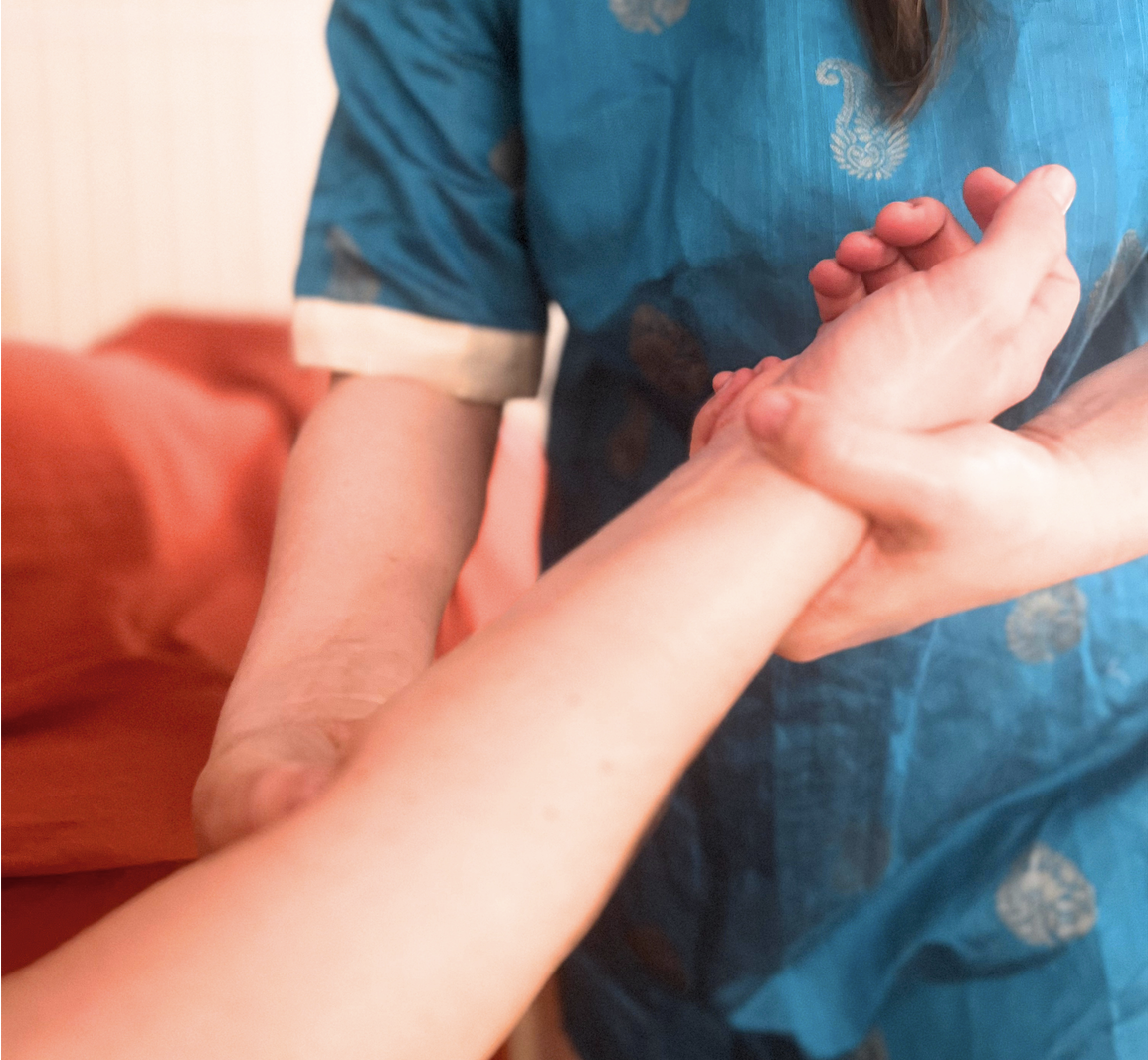
When we work on a Marma through touch, we first enter into a relationship with the physical body. Depending on the Marma and the intention of the session, the practitioner may use different qualities of touch: precise pressure, gentle contact, movement or a more subtle touch.
On a physical level, this touch can act directly on the tissues and structures of the area. It can support the release of certain tensions, enhance awareness of a particular area of the body and support a sense of mobility and comfort.
In the Ayurvedic tradition, Marma touch does not necessarily stop at this mechanical dimension. It can also be used to influence Prana and act on the energetic dimension of the body. Touch then becomes a bridge between what we can experience physically and what is more subtle. Breathing, attention and the practitioner’s quality of presence also become important.
A Marma is therefore not simply a point that we “press”. It is an area of the body that we approach with precision, listen to and consider as a whole.
An approach that resonates with my practice
It is precisely this meeting between several dimensions that speaks to me and that I share through Marma Chikitsa: anatomy and energy, physical touch and Prana, the body and consciousness. This is the vision of the Marmas that I integrate into my practice at Maison Anahé.
Through my training and the years I have spent exploring this field, I have deepened my understanding of different approaches to the Marmas, their location and precision, as well as different qualities of touch.
For me, the richness of this tradition lies precisely in the possibility of considering what is physical, energetic and subtle simultaneously, without separating these dimensions.
To be continued…
In the coming articles of this series, we will continue this journey through the world of the Marmas. We will explore their history, the different traditions that have preserved this knowledge, and the classifications used across different schools.
Welcome to the world of Marma Chikitsa. An ancient science, between the physical body and the subtle dimension, where touch becomes another way of listening.